I Can't Make You Do Anything....
I can't Make. You Do Anything... (Picture was Ai Generated)
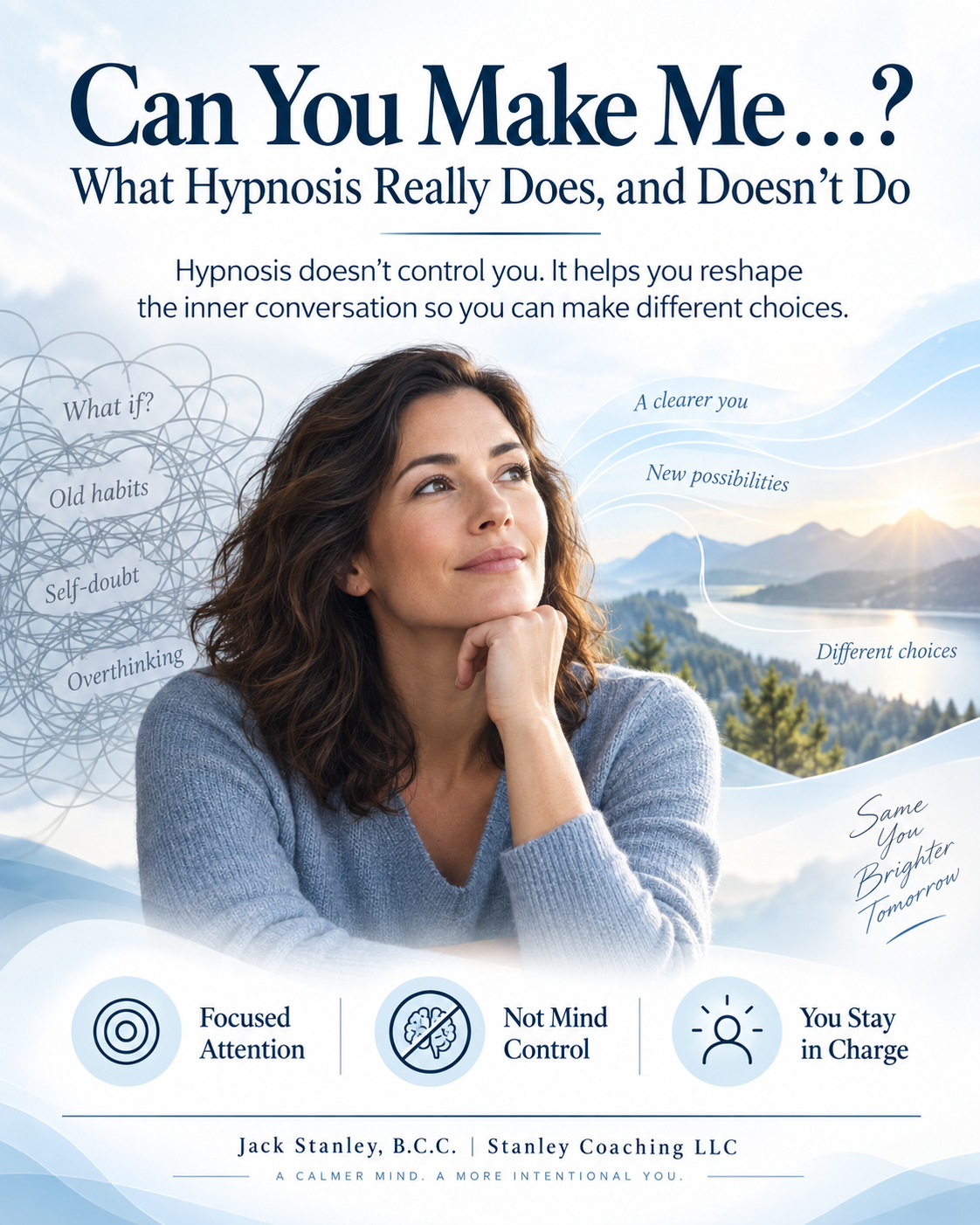
“Can You Make Me…?” What Hypnosis Really Does, and Doesn’t Do
People often ask me, “Can you make me stop smoking?” or “Can you make me sleep?” or “Can you make me successful?” It’s an understandable question, but it rests on a misconception. As a hypnotherapist, I don’t make anyone do anything.
What I do is help you reshape your inner conversations, the stories running just below conscious awareness, so that you can make different choices. The choices are always yours. The American Psychological Association describes hypnosis as a state of focused attention with an increased capacity to respond to suggestion (Elkins et al., 2015). Focused attention and openness are not the same as control. You stay in charge the entire time.
You live your interpretation of reality
In coaching we often say that you don’t live reality itself; you live your interpretation of it. The philosopher Alfred Korzybski put it simply: “The map is not the territory” (Science and Sanity, 1933). Most of us are navigating by maps we inherited from family, culture, and early experience, and many of those maps were drawn long before we could question them.
Hypnosis is one of the most effective ways I know to access those maps and redraw them.
A client story: breaking the ceiling, and then choosing where to stop
Several years ago a client told me, “I can’t break $100,000 a year.” In a single session we worked through that story. We didn’t relive old pain or dig through the past; we simply changed the belief that was holding the limit in place. Within a year he reached his goal of $125,000.
Here’s the part that matters just as much. He has since settled between $125,000 and $150,000. What happened? Nothing went wrong. He rose to the level that matches his current view of life and of his own value. Author Gay Hendricks calls this our “upper limit,” the internal thermostat that sets how much success we allow ourselves (The Big Leap, 2009).
Should he push past it? Not necessarily. He isn’t suffering. He’s content, and that is a valid outcome. Some people go as far as they can see and then feel ready to go further. Others go as far as they can see and find peace there. Both are legitimate.
“Should” is the enemy of self-acceptance
Psychoanalyst Karen Horney wrote about the “tyranny of the shoulds,” the way rigid ideas of who we ought to be crowd out acceptance of who we are (Neurosis and Human Growth, 1950). Albert Ellis, founder of Rational Emotive Behavior Therapy, made a similar point: demanding that life or ourselves “must” be a certain way is a reliable path to distress.
So the real question isn’t “What should I be?” It’s “Who am I, and what do I actually want?” The work isn’t about income, or any single outcome. It’s about alignment between your deeper beliefs, many of them generational, and your current values and focus.
Better sleep works the same way
Sleep problems are often driven by inner dialogue: the replaying, the worrying, the mind that won’t power down. Hypnosis helps quiet and reshape that dialogue so the obstacles to rest fall away.
In my practice, I’ve found that a series of three sessions, not focused on sleep itself but on removing the blocks to sleep, has been very successful in helping people sleep better and wake more rested. We don’t try to force sleep. We clear away what’s standing in its way.
Sleep is a silent state we enter silently and unaware. As it should be.
So, can I help you?
Can I help you become a millionaire, or find a great relationship? Yes. Can I help you find peace right where you are? Also yes. The direction is up to you.
Hypnosis isn’t about reprogramming a person. It’s about opening opportunities: activating your own capacity for healing and for moving forward. It’s one of many tools I use, and one of the most powerful. Jack
Jack Stanley B.C.C.
1320 Arrow Point Dr
Cedar Park, Tx 78613
+1 512 269 8023
www.stanleycoaching.com
jack@stanleycoaching.com
Coaching Life Change tools